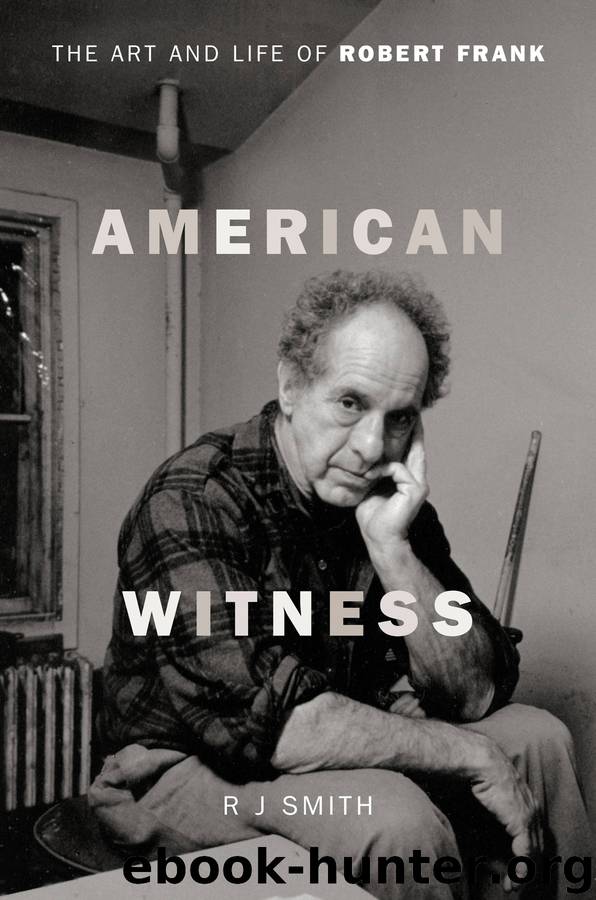
American Witness by RJ Smith
Author:RJ Smith
Language: eng
Format: epub, azw3
Publisher: Da Capo Press
Published: 2017-11-20T16:00:00+00:00
CHAPTER ELEVEN
AN IMPRESSIVE BUNCH OF GUYS
THE FIRE STARTED in the basement, possibly in an area where cloth and plastic were stored. It spread to two adjacent buildings, and before it was extinguished, the blaze at Broadway and 23rd Street cost the lives of twelve New York City firemen. All city flags were at half-mast the following day, per mayor John Lindsay’s decree. The fire also destroyed Alfred Leslie’s studio at 940 Broadway, incinerating a large amount of his work from the past two decades.1
Lost in the fire were prints and numerous outtakes from Pull My Daisy. Frank and Leslie were feuding, and the fire destroyed whatever was left of their friendship. Frank blamed Leslie for the destruction of reels in the loft, while Leslie felt Frank tried to assert ownership of the film afterward.2 “It was very simple: Some partnerships work, some partnerships don’t,” said Leslie. “It only worked on one film, what came to be known as Pull My Daisy.”
Frank’s current film projects made that first film seem part of another era. Strangely enough, though, his photographic work was now enjoying an acceptance broader than ever. While he chipped away at Me and My Brother, using Rooks’s money to buy more film stock, a funny thing was happening to his photographic legacy: he was being celebrated as a prophet who had seen the dark side of America when few wanted to look, a crucial influence on emerging photographers of the late 1960s and 1970s. Almost from the moment he stopped taking photographs, his stature was on the rise.
In January 1962 Edward Steichen assembled an exhibition of work by Frank and Harry Callahan. He had wanted the title to be consistent with a series of previous exhibitions, all titled “Diogenes with a Camera,” but Frank had had it with Steichen’s grand concepts and threatened to pull out unless the title was changed to the simpler “Photographs by Harry Callahan and Robert Frank.” The retitled exhibition more or less finished off whatever was left of their friendship.3 Meanwhile, at the George Eastman House in Rochester, curator Nathan Lyons assembled a one-man exhibition of Frank’s work, and he also struck a deal with Frank, giving him a supply of raw film stock for every print he donated to the institution. The Eastman’s 1965 presentation of The Americans took Frank’s work on the road to museums and galleries on campuses and in small towns and remained on view for fifteen years, helping introduce The Americans to America.
Tribute was being paid in absentia. There was Lyons’s seismic 1966 “Toward a Social Landscape” at the Eastman House, an exhibition featuring photographers Bruce Davidson, Lee Friedlander, Garry Winogrand, Duane Michals, and Danny Lyon, all of whom had been inspired by Frank.4 Through the artists he selected, Lyons argued that “point of view” was as essential a subject for contemporary photography as was the natural environment. A year later came the Museum of Modern Art’s marquee “New Documents” exhibition, presenting the work of the then fairly unknown Diane Arbus along with Friedlander and Winogrand.
Download
This site does not store any files on its server. We only index and link to content provided by other sites. Please contact the content providers to delete copyright contents if any and email us, we'll remove relevant links or contents immediately.
Cecilia; Or, Memoirs of an Heiress — Volume 2 by Fanny Burney(31942)
Cecilia; Or, Memoirs of an Heiress — Volume 3 by Fanny Burney(31928)
Fanny Burney by Claire Harman(26594)
We're Going to Need More Wine by Gabrielle Union(19033)
Plagued by Fire by Paul Hendrickson(17403)
All the Missing Girls by Megan Miranda(15945)
Cat's cradle by Kurt Vonnegut(15333)
Bombshells: Glamour Girls of a Lifetime by Sullivan Steve(14050)
For the Love of Europe by Rick Steves(13896)
Leonardo da Vinci by Walter Isaacson(13315)
4 3 2 1: A Novel by Paul Auster(12371)
The remains of the day by Kazuo Ishiguro(8969)
Adultolescence by Gabbie Hanna(8917)
Note to Self by Connor Franta(7663)
Diary of a Player by Brad Paisley(7558)
Giovanni's Room by James Baldwin(7323)
What Does This Button Do? by Bruce Dickinson(6194)
Ego Is the Enemy by Ryan Holiday(5413)
Born a Crime by Trevor Noah(5372)
